This is the second of the four problems on the A533B-1 welded plate, and the companion to Problem 1 LLAW. The two problems were designed for a single-variable comparison:
The shared background and method for all four problems are in the overview Where do residual stresses push the assessment point?.
What this problem asks
LLHT = Low-$L_r$ + Heat-Treated: post-weld heat treatment (PWHT) applied, assessment temperature −120 ℃, low load ratio. It is at the same temperature as LLAW, in the same region, and uses the same set of measured residual-stress profiles — the only variable is PWHT. The heat treatment relaxes the welding residual stress by at least an order of magnitude, so the residual $K_I^S$ drops from 46 in the as-welded state to 5 MPa·m$^{0.5}$. The load capacity rises accordingly, from LLAW’s 1.27 MN to 2.19 MN (about 1.7×).
The question this problem answers is the comparison question: if you relax the residual stress, how far does the assessment point fall back?
Principle: same yardstick, only the residual term changes
The assessment still follows BS 7910:2019 §7.3.3 Option 1, with coordinate definitions identical to Problem 1:
$$ K_r = \frac{K_I^P + K_I^S}{K_{mat}} + \rho, \qquad L_r = \frac{\sigma_{ref}}{\sigma_Y} $$Residual stress is a secondary stress, so it enters $K_r$ only, not $L_r$ (§7.3.6). The only thing this comparison problem actually changes is the $K_I^S$ term in the $K_r$ numerator: from 46 to 5.
Inputs at a glance
| Parameter | Value | Difference vs. LLAW |
|---|---|---|
| Crack depth $a_0$ / half-length $c_0$ | 18.6 / 87 mm | almost the same |
| Plate thickness $B=t$ / width $W$ | 71 / 600 mm | the same |
| Primary membrane $P_m$ / bending $P_b$ | 0 / 424 MPa | higher load (fracture load 2.19 MN) |
| Yield $\sigma_Y$ / tensile $\sigma_U$ | 596 / 772 MPa | similar |
| Fracture toughness $K_{mat}$ | 46 MPa·m$^{0.5}$ | PWHT weld @ −120 ℃ |
| Residual $K_I^S$ (direct input) | 5 MPa·m$^{0.5}$ | 46 → 5 (relaxed by an order of magnitude) |
Entering it in the calculator
The input steps are the same as Problem 1 (first pick Option 1 under Assessment Option (FAD) at the top, then fill in geometry, stress, material and toughness from the cards). For this problem you only need to swap three values to the LLHT ones: primary bending $P_b=424$, fracture toughness $K_{mat}=46$, and secondary $K_I^S$ entered directly as 5. The plasticity interaction $\rho$ still uses the default Annex R auto-calculation.
Results
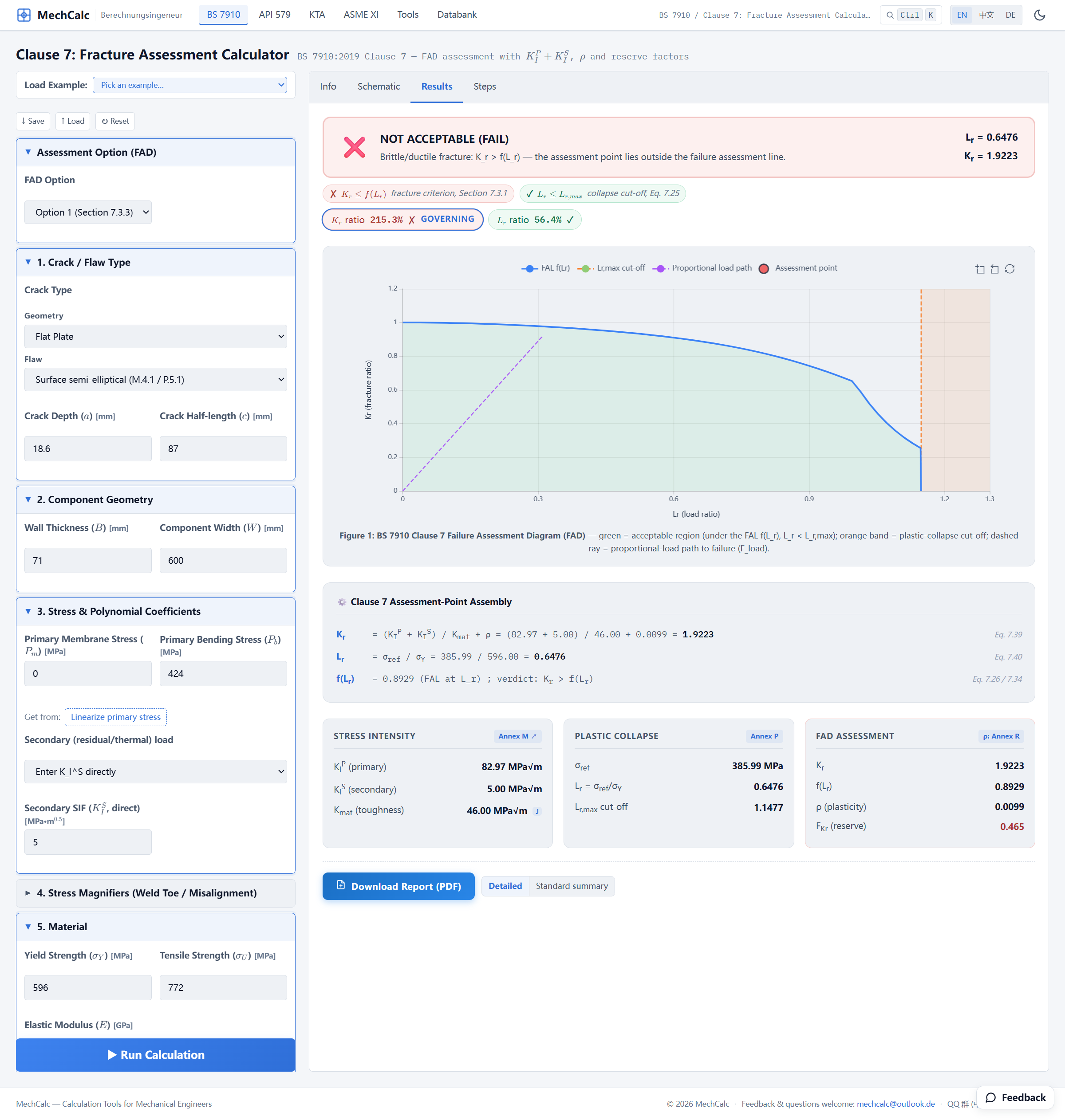
Figure 1: LLHT results. Assessment point (L_r, K_r)=(0.648, 1.92). Note the lower right: the primary K_I^p=82.97 is actually higher than LLAW’s 48.13, but the secondary K_I^s is only 5.00 (LLAW was 46), so the assessment point lands lower.
| Quantity | LLHT | (LLAW for comparison) |
|---|---|---|
| Primary $K_I^P$ | 82.97 MPa·m$^{0.5}$ | 48.13 |
| Secondary $K_I^S$ | 5.00 MPa·m$^{0.5}$ | 46.00 |
| Reference stress $\sigma_{ref}$ | 386.0 MPa | 226.5 |
| Plasticity interaction $\rho$ | 0.010 | 0.046 |
| Horizontal axis $L_r$ | 0.648 | 0.367 |
| Vertical axis $K_r$ | 1.92 | 2.59 |
| Verdict | not acceptable | not acceptable |
Reading the result: the counter-intuitive pair to watch
The most thought-provoking thing in this problem is a counter-intuitive result:
- LLHT’s primary stress intensity factor $K_I^P = 82.97$ is nearly double LLAW’s 48.13 (because LLHT fractured under the higher load of 2.19 MN);
- yet its assessment point $K_r = 1.92$ is lower than LLAW’s 2.59.
The whole difference is in the secondary term: the as-welded residual $K_I^S = 46$, but after PWHT only 5 remains. Between that drop and the rise on the primary side, PWHT pulls the vertical coordinate from 2.59 back down to 1.92. This turns “residual stress is harmful” from a qualitative statement into a quantifiable increment on the FAD vertical axis — in the brittle-fracture-governed low-$L_r$ region, as-welded residual stress can contribute a $K_I^S$ on the same order as the primary stress.
Both are judged not acceptable (both did fracture in the test), but PWHT lets LLHT carry 1.7× the load before fracturing — which is the direct engineering basis for insisting on post-weld heat treatment of important welds.
Cross-check against FITNET: is mechCalc accurate?
As before, we line up this problem’s assessment against the FITNET original term by term to check mechCalc’s accuracy:
| Quantity | mechCalc | FITNET original | Difference |
|---|---|---|---|
| Primary $K_I^P$ [MPa·m$^{0.5}$] | 82.97 | ≈83 | ≈0 |
| Secondary $K_I^S$ [MPa·m$^{0.5}$] | 5.0 | 5 | same source |
| Load ratio $L_r$ | 0.648 | 0.64 | +1.2% |
| Fracture ratio $K_r$ | 1.92 | 1.89 | +1.7% |
In the low-$L_r$ region the two implementations again agree closely: $L_r$ differs by 1.2% and $K_r$ by 1.7%, both within ±2%. In this comparison problem mechCalc reproduces the trend (“PWHT pulls $K_r$ from 2.59 back to 1.92”) and also matches the FITNET original numerically — one more piece of evidence for its accuracy.
Source: the FITNET project’s Case Studies for Fracture, case “A533B-1 Steel Residual Stress Experiments”; original test report C C France, J K Sharples & C Wignall, AEA Technology Report AEAT-4236 (SINTAP/TASK4/AEAT18, 1998). The residual $K_I^S$ is from the same source on both sides; the primary SIF and limit-load solutions come from different sources (FITNET uses Sharples & Clayton / Sattari-Far, mechCalc uses BS 7910 Annex M / Annex P).
Next: raise the temperature to −30 ℃ and increase the load into the high-$L_r$ (large-plasticity) region — is residual stress still that important? See Problem 3 HLAW.
🧮 在线计算器:BS 7910 Clause 7 Fracture Assessment Calculator — Re-run this comparison problem: starting from the Problem 1 inputs, change P_b to 424, K_mat to 46, and enter K_I^S directly as 5, to get L_r=0.648, K_r=1.92.