This is the third of four problems on the welded A533B-1 plate. The first two both sat in the low load-ratio brittle-fracture regime and compared residual stress; this one shifts the battlefield — to the high load-ratio, large-plasticity regime.
For the shared background and method behind all four problems, see the overview post Where does residual stress push the assessment point?.
What this problem asks
HLAW = High-$L_r$ + as-Welded: as-welded condition, assessment temperature raised to −30 ℃, load increased into the high load-ratio regime. The warmer temperature lifts the fracture toughness somewhat off the lower shelf ($K_{mat}=62\ \mathrm{MPa\cdot m^{0.5}}$), while the load is raised to a failure load of 5.10 MN. The residual stress stays the as-welded value ($K_I^S=46$).
The question becomes: once plasticity has developed extensively in the high-$L_r$ regime, does that residual stress — so dominant in the low-temperature regime — still call the shots?
Principle: once $L_r$ crosses the cut-off, the assessment is governed by plastic collapse
The assessment is still BS 7910:2019 §7.3.3 Option 1, but this problem triggers the FAD’s plastic cut-off mechanism. BS 7910:2019 §7.3.2 defines a cut-off value to prevent the net section from collapsing plastically before fracture occurs:
$$ L_{r,max} = \frac{\sigma_Y + \sigma_U}{2\sigma_Y} $$When the assessment point’s abscissa reaches $L_r \ge L_{r,max}$, the failure assessment line takes $f(L_r)=0$ (§7.3.3 Eq. 7.28) — meaning that however low the ordinate, the flawed structure is not acceptable because of plastic collapse / net-section yielding. Here $\sigma_Y=520$ and $\sigma_U=677$, which gives $L_{r,max}\approx 1.15$.
In addition, the plasticity interaction $\rho$ from BS 7910 Annex R is defined only within $L_r \le L_{r,max}$; past the cut-off, $\rho$ is taken as 0.
Inputs at a glance
| Parameter | Value | Note |
|---|---|---|
| Crack depth $a_0$ / half-length $c_0$ | 19.0 / 87 mm | Full length $2c_0=174$ mm |
| Thickness $B=t$ / width $W$ | 70 / 600 mm | |
| Primary membrane $P_m$ / bending $P_b$ | 0 / 1015 MPa | Pure bending (elastic conversion of the 5.10 MN fracture load) |
| Yield $\sigma_Y$ / tensile $\sigma_U$ | 520 / 677 MPa | $L_{r,max}\approx 1.15$ |
| Fracture toughness $K_{mat}$ | 62 MPa·m$^{0.5}$ | As-welded weld @ −30 ℃ |
| Residual $K_I^S$ (direct input) | 46 MPa·m$^{0.5}$ | Same as LLAW (as-welded) |
Entering it in the calculator
The steps match the first two problems (pick Option 1 at the top, then fill in the cards). Here you swap in the HLAW values: thickness 70, primary bending $P_b=1015$, yield 520, tensile 677, $K_{mat}=62$, and the secondary $K_I^S$ entered directly as 46. Leave $\rho$ on the Annex R auto-calculation (the engine sets it to 0 automatically once the cut-off is crossed).
Results
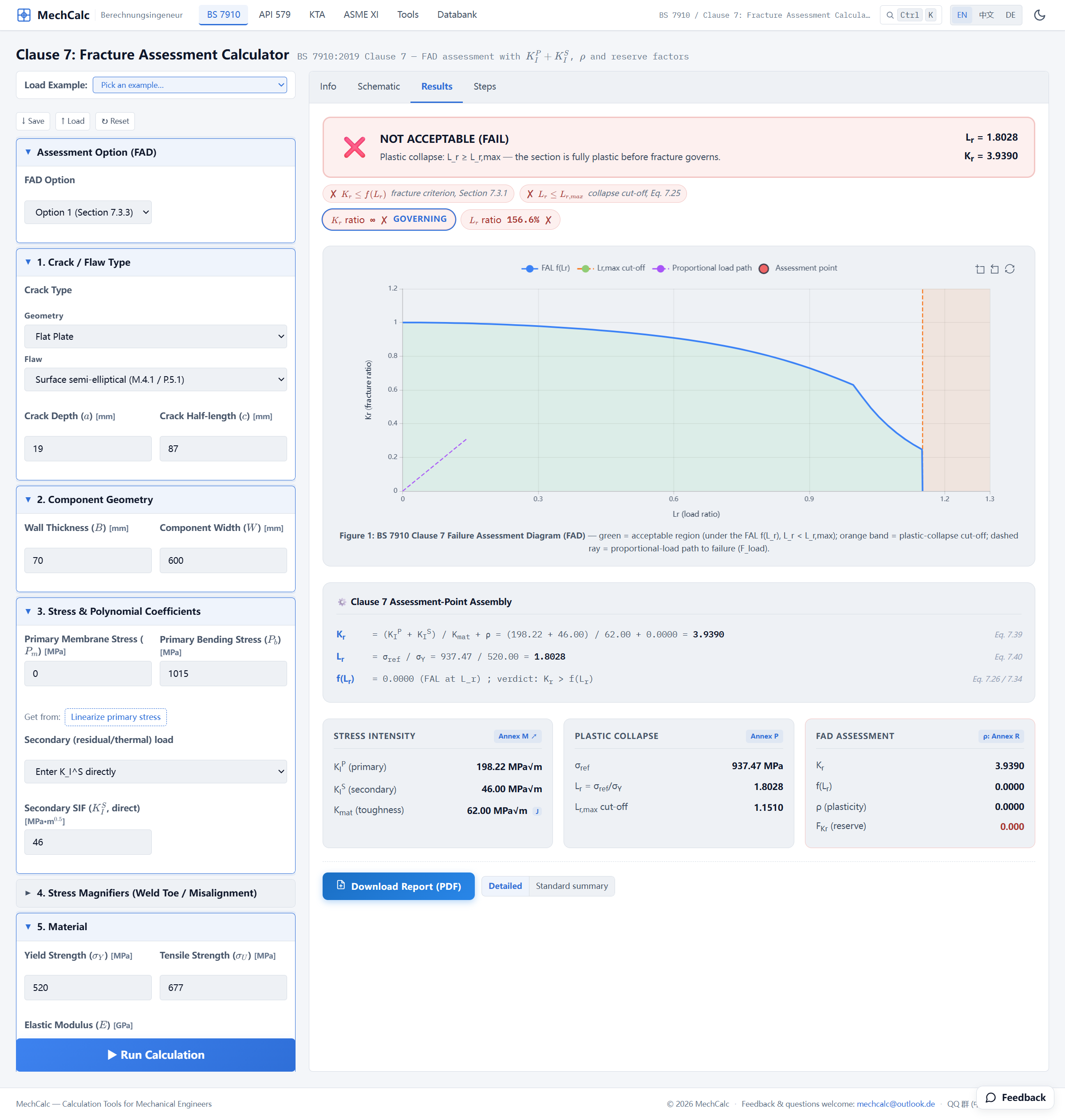
Figure 1: HLAW results. L_r=1.80 already exceeds the plastic cut-off value (about 1.15), so the assessment point lands to the right of the cut-off line and is judged NOT ACCEPTABLE — the message reads the section is fully plastic before fracture governs. Note ρ=0 and f(L_r)=0.
| Quantity | Value | Note |
|---|---|---|
| Primary $K_I^P$ | 198.22 MPa·m$^{0.5}$ | Markedly larger under the high load |
| Secondary $K_I^S$ | 46.00 MPa·m$^{0.5}$ | As-welded residual |
| Reference stress $\sigma_{ref}$ | 937.5 MPa | Close to yield |
| Plasticity interaction $\rho$ | 0 (past cut-off) | §7.3.2 |
| Abscissa $L_r$ | 1.80 | $> L_{r,max}\approx 1.15$ |
| Ordinate $K_r$ | 3.94 | |
| Verdict | Not acceptable (governed by plastic collapse) | $L_r \ge L_{r,max}$ |
Reading the result
The abscissa $L_r = 1.80$ is far beyond the plastic cut-off value $L_{r,max}\approx 1.15$. On the FAD, the assessment point falls to the right of the cut-off vertical line — the side controlled by plastic collapse / net-section yielding — so the flawed structure is judged not acceptable, consistent with the test fracture.
More telling still is that the governing factor has changed. The ordinate $K_r$ reaches 3.94, but this time the main thing driving it up is no longer residual stress: in the large-plasticity regime, secondary stresses such as residual stress are “diluted” by plastic deformation (this is also the physical reason $\rho$ drops to zero past the cut-off and stops amplifying secondary stress). The real weak point is the low fracture toughness — even at −30 ℃, the as-welded weld only reaches $K_{mat}=62$.
In other words: the low-$L_r$ regime (Problems 1 and 2) is a contest over residual stress, whereas the high-$L_r$ regime is a contest over toughness and net-section strength. For one and the same set of specimens, where the operating point sits on the FAD decides who the weak link is — and that is exactly the value of the failure assessment diagram, which unifies brittle fracture and plastic collapse on a single chart.
Cross-check against FITNET: is mechCalc accurate?
Setting this high-$L_r$ assessment side by side with the FITNET source, item by item:
| Quantity | mechCalc | FITNET source | Difference |
|---|---|---|---|
| Primary $K_I^P$ [MPa·m$^{0.5}$] | 198.2 | ≈198 | ≈0 |
| Secondary $K_I^S$ [MPa·m$^{0.5}$] | 46.0 | 46 | Same source |
| Load ratio $L_r$ | 1.80 | 1.72 | +4.8% |
| Fracture ratio $K_r$ | 3.94 | 3.79 | +3.9% |
In the high-$L_r$ regime the gap widens to about 4–5% — but this is not error, it is a methodological difference. For the reference stress in the large-plasticity regime, mechCalc uses the closed-form expression from BS 7910 Annex P, whereas the FITNET source switches to 3D finite-element analysis under strength mismatch; two ways of solving the same physical quantity will naturally differ by a few percent, and here they differ in the same direction, with mechCalc on the slightly more conservative side (its assessment point sits further out, giving a safer verdict). Most importantly, the verdicts agree completely: $L_r$ crosses the cut-off, plastic collapse, not acceptable. The difference therefore sits at the level of “solution accuracy” and does not affect the engineering conclusion — mechCalc’s accuracy and conservatism both hold up.
Source: the FITNET project’s Case Studies for Fracture, case “A533B-1 Steel Residual Stress Experiments”; original test report C C France, J K Sharples & C Wignall, AEA Technology Report AEAT-4236 (SINTAP/TASK4/AEAT18, 1998).
The closing problem: same −30 ℃ and high-$L_r$ regime, but with PWHT applied — relaxing the residual stress and raising the toughness by an order of magnitude ($K_{mat}$ jumps from 62 to 321). $K_r$ will collapse, but will the conclusion flip? See Problem 4, HLHT.
🧮 在线计算器:BS 7910 Clause 7 Fracture Assessment Calculator — Rerun this problem: P_b=1015, σ_Y=520, σ_U=677, K_mat=62, K_I^S entered directly as 46, and you get L_r=1.80 (past the cut-off), K_r=3.94.