This is the finale of the four problems on the A533B-1 welded plate. It is the counterpart to Problem 3, HLAW, and it pushes the power of PWHT in this test series into its most visible form.
The shared background and method for all four problems are covered in the overview, Where does residual stress push the assessment point?.
What this problem asks
HLHT = High-$L_r$ + Heat-Treated: PWHT applied, assessment temperature −30 ℃, high load ratio. It shares the temperature and regime of HLAW, and the difference is still that one thing — post-weld heat treatment. But at −30 ℃, PWHT delivers a double dividend:
- Relaxed residuals: the residual $K_I^S$ drops from 46 in the as-welded state to 5 MPa·m$^{0.5}$;
- Restored toughness: −30 ℃ is already close to the ductile-brittle transition region, and PWHT lifts the weld toughness off the lower shelf, raising it by an order of magnitude — $K_{mat}$ jumps from 62 in HLAW to 321 MPa·m$^{0.5}$.
These two effects together pull the vertical coordinate $K_r$ down sharply. But does that overturn the verdict? That is exactly what makes this finale worth watching.
Principle: the vertical coordinate collapses, yet the horizontal one may still cross the line
The assessment is still BS 7910:2019 §7.3.3 Option 1. Both terms in the numerator of $K_r$ shrink (smaller residual, larger $K_{mat}$), so the vertical coordinate must fall a great deal. But remember the FAD is a two-dimensional criterion: besides keeping the vertical $K_r$ below the failure assessment line, the horizontal axis must also satisfy $L_r < L_{r,max}$ (the plastic cut-off, §7.3.2):
$$ L_{r,max} = \frac{\sigma_Y + \sigma_U}{2\sigma_Y} \approx 1.15 \quad (\sigma_Y=520,\ \sigma_U=677) $$No amount of toughness can save a section that has already reached net-section yielding ($L_r \ge L_{r,max}$).
Inputs at a glance
| Parameter | Value | Difference from HLAW |
|---|---|---|
| Crack depth $a_0$ / half-length $c_0$ | 19.0 / 87 mm | same |
| Plate thickness $B=t$ / width $W$ | 70 / 600 mm | same |
| Primary membrane $P_m$ / bending $P_b$ | 0 / 960 MPa | slightly lower (fracture load 4.83 MN) |
| Yield $\sigma_Y$ / tensile $\sigma_U$ | 520 / 677 MPa | same |
| Fracture toughness $K_{mat}$ | 321 MPa·m$^{0.5}$ | 62 → 321 (order-of-magnitude rise) |
| Residual $K_I^S$ (direct input) | 5 MPa·m$^{0.5}$ | 46 → 5 (relaxed) |
Entering it in the calculator
The steps are the same as the first three problems (pick Option 1 at the top, then fill the cards). Relative to HLAW, three things change here: primary bending $P_b=960$, fracture toughness $K_{mat}=321$, and the secondary $K_I^S$ entered directly as 5. The $\rho$ term is still computed automatically by Annex R.
Results
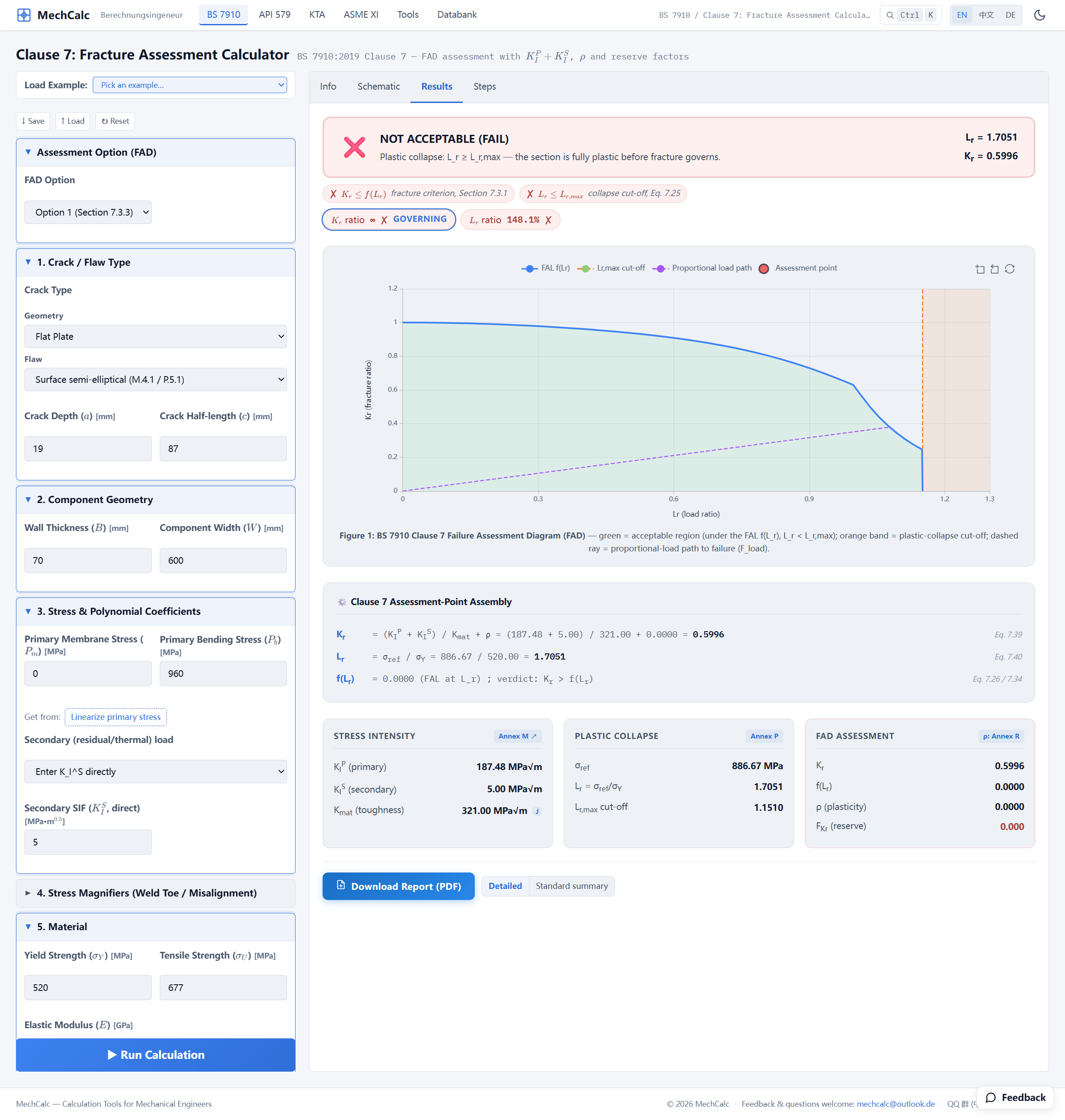
Figure 1: HLHT results. K_r is only 0.60 (the high toughness K_mat=321 presses the vertical coordinate far down), but L_r=1.71 still crosses the plastic cut-off (about 1.15), so the assessment point lands to the right of the cut-off line — the NOT ACCEPTABLE verdict is driven by plastic collapse, not fracture.
| Quantity | HLHT | (HLAW for comparison) |
|---|---|---|
| Primary $K_I^P$ | 187.5 MPa·m$^{0.5}$ | 198.2 |
| Secondary $K_I^S$ | 5.00 MPa·m$^{0.5}$ | 46.00 |
| Fracture toughness $K_{mat}$ | 321 MPa·m$^{0.5}$ | 62 |
| Reference stress $\sigma_{ref}$ | 886.7 MPa | 937.5 |
| Horizontal $L_r$ | 1.71 | 1.80 |
| Vertical $K_r$ | 0.60 | 3.94 |
| Verdict | not acceptable (plastic collapse) | not acceptable (plastic collapse) |
Reading the result
First, the power of PWHT: $K_r$ plunges from 3.94 in HLAW to 0.60. Almost all of that drop comes from $K_{mat}$ rising from 62 to 321 — the denominator of the vertical coordinate is five times larger — while the residual term shrinks from 46 to 5. Look at the vertical axis alone and HLHT seems perfectly safe.
But the FAD is a two-dimensional criterion. The horizontal $L_r = 1.71$ still crosses the plastic cut-off $L_{r,max}\approx 1.15$, and the assessment point lands to the right of the vertical cut-off line — the flawed structure is judged not acceptable because of plastic collapse, consistent with the test fracture. No amount of toughness can stop a net section that has already yielded fully from failing. In this problem the governing mode of the verdict has switched completely from fracture to plastic collapse.
Finally, that thought-provoking twist: HLHT has smaller residuals and five times the toughness, yet its failure load (4.83 MN) is slightly lower than HLAW’s (5.10 MN). Far from being a contradiction, this confirms the conclusion of Problem 3 — in the high-$L_r$ regime the relative influence of residual stress has already been “diluted” by plasticity, and the governing factors return to toughness and net-section yield strength. The two specimens have the same yield/tensile strengths, so their net-section load capacities are already close; further increasing toughness is no longer the bottleneck here, so the failure loads naturally land in the same range and trade places by a small margin.
Cross-check against FITNET: is mechCalc accurate?
The finale is likewise compared term by term against the original FITNET text:
| Quantity | mechCalc | FITNET original | Difference |
|---|---|---|---|
| Primary $K_I^P$ [MPa·m$^{0.5}$] | 187.5 | ≈187 | ≈0 |
| Secondary $K_I^S$ [MPa·m$^{0.5}$] | 5.0 | 5 | same source |
| Load ratio $L_r$ | 1.71 | 1.63 | +4.6% |
| Fracture ratio $K_r$ | 0.60 | 0.57 | +5.2% |
As with Problem 3, the difference in the high-$L_r$ regime is about 5%, arising from the method difference in the reference-stress solution (the Annex P closed-form expression vs 3D finite-element analysis); the direction is consistent and mechCalc is slightly conservative. The verdict (plastic collapse, not acceptable) is identical on both sides.
Source: the FITNET project’s Case Studies for Fracture, case “A533B-1 Steel Residual Stress Experiments”; original test report C C France, J K Sharples & C Wignall, AEA Technology Report AEAT-4236 (SINTAP/TASK4/AEAT18, 1998).
Tying the four problems together
Looking at the four problems together, this set of A533B-1 tests yields a complete picture:
- Low-$L_r$ brittle-fracture regime (LLAW/LLHT): residual stress is the lead actor. As-welded residuals can contribute a $K_I^S$ on the order of a primary stress, pushing the assessment point markedly higher; relaxing the residuals with PWHT pulls it back down substantially.
- High-$L_r$ plastic regime (HLAW/HLHT): residuals are diluted by plasticity, and the lead role passes to toughness and net-section strength; the verdict is governed by plastic collapse ($L_r \ge L_{r,max}$).
- The value of PWHT is twofold: it both relaxes the residuals and (in the transition region) restores toughness — but it cannot save a section that has already reached net-section yielding.
And mechCalc’s BS 7910 Clause 7 fracture-assessment engine independently reproduces the published assessment results for all four problems ($L_r$ and $K_r$ both agreeing within ±5%), showing that it assembles the residual-stress step — the most error-prone part — correctly, and is fit for engineering assessment.
🧮 在线计算器:BS 7910 Clause 7 Fracture Assessment Calculator — Rerun this finale: P_b=960, K_mat=321, K_I^S entered directly as 5, giving K_r=0.60 and L_r=1.71 (still beyond the cut-off).