1. Overview
The bolt (German: Schrauben) is the earliest and most widely used machine connection element in mechanical engineering. Compared with other connection methods, the bolt has the largest number and the richest variety of standardized forms.
1.1 The thread line on a bolt
The core of a bolted joint is the form fit (German: Formschluss) between the bolt (external thread) and the clamped part (usually the internal thread of a nut).
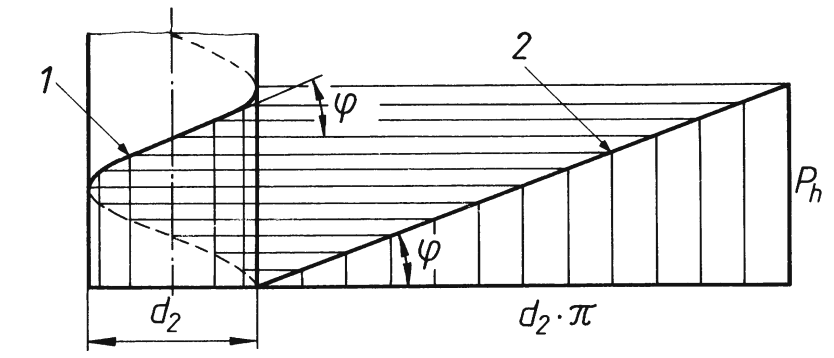
Unrolled, a thread is essentially an inclined plane. The figure shows how a thread line is formed.
1. Once unrolled, a thread is essentially an inclined plane.
When the bolt and nut rotate relative to each other, the flank of the bolt thread slides over the flank of the nut thread. Through this sliding process on the “inclined plane”, the thread structure can perfectly turn rotary motion into a longitudinal linear displacement. Based on this “inclined-plane principle” of turning rotation into linear motion, this kind of thread (motion screw) is widely used to transmit motion or produce large thrust/pull, for example the lead screw of a lathe, a screw press, a screw jack, a bench vice and screw clamps.
- Line 1 is the thread line (or helix). This is a space curve on a cylindrical surface, representing the actual motion path of the thread.
- Line 2 is the inclined plane. The two-dimensional geometry obtained by unrolling the thread line on the cylinder along the tangent plane; it is the theoretical basis of thread force analysis.
- $\varphi$ (German: Gewindesteigungswinkel): the lead angle. In the unrolled inclined-plane model, the angle between the inclined plane and the horizontal base.
- $P$ (German: Gewindesteigung): the pitch (or lead). The axial distance the bolt or nut moves per full relative revolution, corresponding to the vertical height of the unrolled inclined plane.
- $d_2$ (German: Flankendurchmesser): the pitch diameter. The effective reference diameter for computing thread friction and geometric unrolling.
- $d_2 \cdot \pi$ (or $r \cdot 2\pi$): the circumference at the pitch diameter. The horizontal base length of the inclined-plane model, corresponding to one turn of the thread unrolled at the pitch diameter.
[!tip] Functional classification of bolts
- Fastening bolts (German: Befestigungsschrauben): used to create a clamping joint. Rotary motion presses two (or more) components together, turning kinetic energy into potential energy. This potential energy can resist the service load along the bolt axis, produce friction in a coupling, prevent the joint from loosening, or seal an interface.
- Motion screws (German: Bewegungsschrauben): similar to a screw mechanism, used to turn rotary motion into linear motion or to produce large forces, for example a lathe lead screw, a screw press, a jack, etc.
- Sealing and adjusting bolts (German: Dichtungs- und Einstellschrauben): used to close an opening (such as an oil-pan sealing plug), or to adjust a clearance (such as a valve-clearance adjusting bolt).
1.2 Thread types (German: Gewinde)
A thread is a profiled groove formed along a helix on a cylindrical surface. The key parameters that decide the thread’s characteristics are:
- Profile shape (German: Profilform): such as triangular (German: Dreieck), trapezoidal (German: Trapez), etc.
- Pitch / lead (German: Steigung / P_h): decides the axial displacement per revolution.
- Number of starts (German: Gangzahl): single-start or multi-start.
- Hand (German: Windungssinn): right-hand or left-hand.
1.2.1 Common thread types and technical standards
- Metric ISO thread (German: Metrisches ISO-Gewinde, DIN 13):
- Flank angle (German: Flankenwinkel) of $60^\circ$.
- Divided into coarse (German: Regelgewinde) (such as M16) and fine (German: Feingewinde) (such as M20×2). Coarse is most common for ordinary fastening; fine is often used for thin-walled parts, seals, or high-strength needs.
- Pipe thread (German: Rohrgewinde, DIN EN ISO 228): used for pipe connections that are not sealed on the thread, flank angle $55^\circ$ (such as G1/2). Where thread sealing is needed, a tapered external thread with a parallel internal thread is used (DIN EN 10226).
- Metric trapezoidal thread (German: Metrisches ISO-Trapezgewinde, DIN 103):
- Flank angle $30^\circ$ (such as Tr36×6).
- The preferred motion thread, used for lead screws, presses, etc.
- Buttress thread (German: Sägengewinde, DIN 513):
- Load flank angle $3^\circ$, non-load flank $30^\circ$.
- Higher load capacity than the trapezoidal thread, with a small friction torque, suitable for transmitting very large loads in one direction, such as a heavy hydraulic press.
1.2.2 Geometric relationship formula
Unrolling the helix on the cylinder gives the thread’s lead angle (German: Steigungswinkel, $\varphi$), referenced to the pitch diameter (German: Flankendurchmesser, $d_2$).
$$ \tan \varphi = \frac{P_h}{d_2 \cdot \pi} $$Variables:
- $P_h$: thread lead (German: Gewindesteigung), the axial displacement per revolution [mm].
- For a multi-start thread, the lead $P_h = n \cdot P$ ($n$ is the number of starts, $P$ is the pitch, German: Teilung).
- For a single-start thread, the lead equals the pitch ($P_h = P$).
- $d_2$: thread pitch diameter [mm].
[!important] You will later find that the pitch diameter $d_2$ keeps appearing in all kinds of standardized calculations — why is it so important?
Because in all thread force analysis (especially the calculation of friction torque and self-locking), the force point is simplified to act on the cylindrical surface formed by the thread pitch diameter $d_2$. From now on, try to build an intuitive sense of the pitch diameter $d_2$, and save yourself some detours.
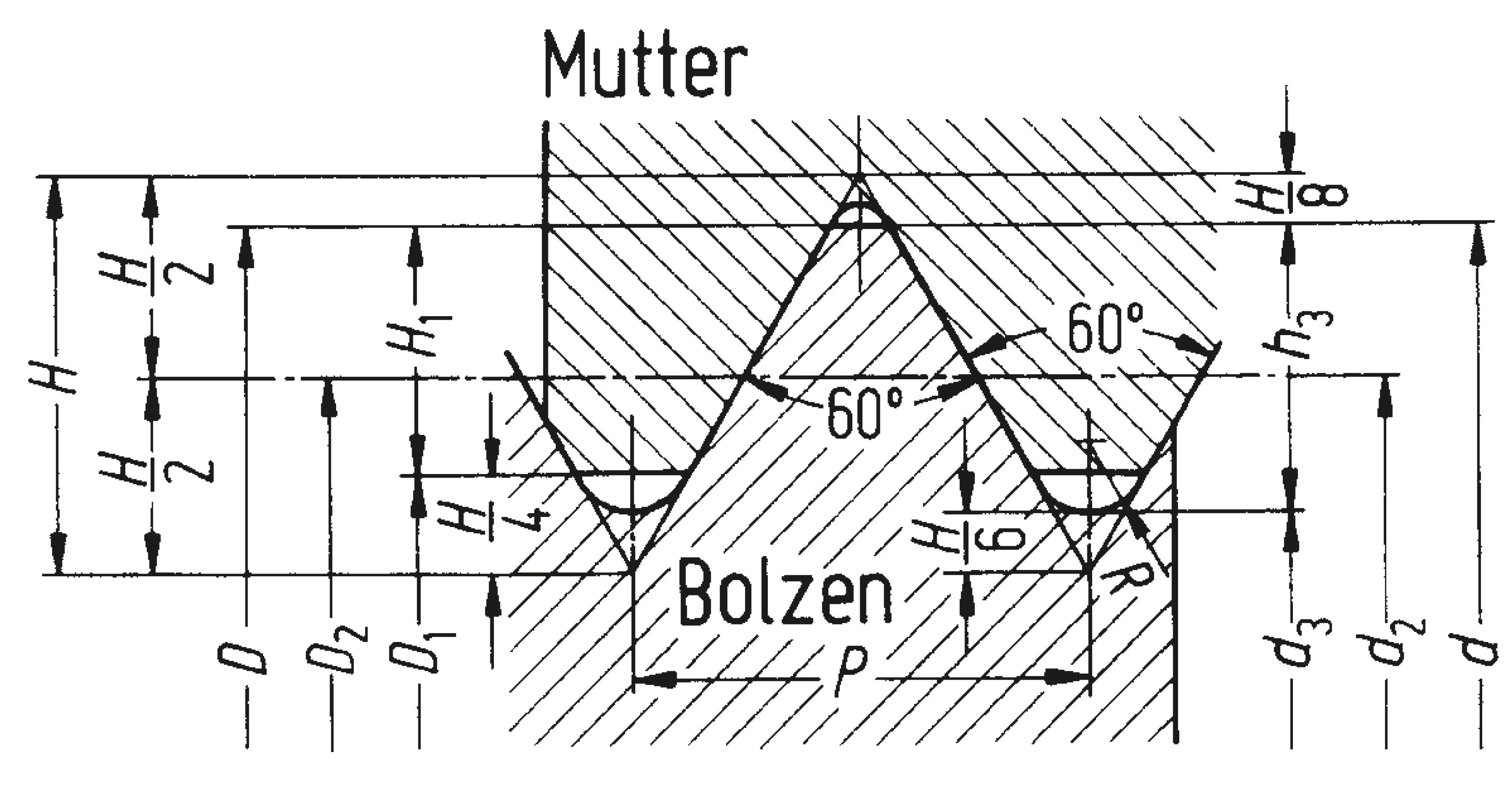 Metric ordinary thread: the various diameters and dimensions of the bolt (German: Schraube) and the nut (German: Mutter).
1. Diameter parameters (German: Durchmesser)
- $d$ / $D$ (German: Nenndurchmesser / Außendurchmesser): nominal diameter / major diameter. $d$ is the major diameter of the external thread (bolt), $D$ is the major diameter of the internal thread (nut).
- $d_2$ / $D_2$ (German: Flankendurchmesser): pitch diameter. The diameter of an imaginary cylinder whose generatrix passes through the point where the groove and ridge widths of the profile are equal.
- $d_3$ (German: Kerndurchmesser der Schraube): minor (root) diameter of the external thread. The minimum core cross-section diameter of the bolt thread.
- $D_1$ (German: Kerndurchmesser der Mutter): minor diameter of the internal thread. The innermost diameter of the nut thread.
2. Cross-section parameters (German: Querschnitte)
- $A_S$ (German: Spannungsquerschnitt): stress cross-section. The effective cross-section for computing the bolt under tension (an equivalent cross-section between the pitch and minor diameters).
- $A_3$ (German: Kernquerschnitt): root / core cross-section. The minimum cross-section computed from the bolt minor diameter $d_3$, often used for compression and similar checks.
3. Profile and height parameters (German: Profil und Höhen)
- $P$ (German: Teilung / Steigung bei eingängigen Gewinden): pitch. The axial distance between corresponding points of two adjacent threads on the pitch line.
- $P_h$ (German: Steigung bei mehrgängigen Gewinden): lead. The axial displacement per revolution (for a multi-start thread $P_h = n \cdot P$, $n$ is the number of starts).
- $H$ (German: Höhe des spitzwinkligen Profildreiecks): height of the fundamental triangle. The total height of the theoretical sharp-cornered thread profile triangle (for a metric thread $H = 0.86603 P$).
- $H_1$ (German: Tragtiefe / Flankenüberdeckung): thread working height / contact height. The radial overlap height of the mating thread flanks when the internal and external threads are engaged ($H_1 = 0.54127 P$).
- $h_3$ (German: Gewindetiefe): external thread depth. The actual radial distance from crest to root of the external thread ($h_3 = 0.61343 P$).
- $R$ (German: Rundungsradius im Gewindegrund): root fillet radius. The arc transition radius at the bolt root, used to reduce stress concentration ($R = H/6$).
4. Angle and friction parameters (German: Winkel und Reibung)
- $\varphi$ or $\alpha$ (German: Steigungswinkel): lead angle. The angle between the helix and the plane perpendicular to the thread axis, after unrolling the pitch-diameter cylinder.
- $\beta$ (German: Flankenwinkel / Spitzenwinkel): flank angle. The angle between the two flanks of the thread profile in the axial section ($60^\circ$ for a metric ordinary thread, $30^\circ$ for a trapezoidal thread).
- $\mu_G$ or $\tan \varrho'$ (German: Gewindereibungszahl): thread friction coefficient. The equivalent friction coefficient between the mating thread surfaces.
- $\varrho'$ (German: Gewindereibungswinkel): equivalent thread friction angle. An imaginary friction angle introduced when computing friction in the thread pair.
1.3 Fastener types and selection
1.3.1 Bolt types (German: Schraubenarten)
The head shape depends on the tightening tool. Internal drives such as the hexagon socket and the Torx allow a smaller head, saving space.
- Hexagon-head bolt (German: Sechskantschrauben, DIN EN ISO 4014/4017): the most common bolt type in mechanical engineering.
- Socket-head cap screw (German: Zylinderschrauben mit Innensechskant, DIN EN ISO 4762): often used for high-strength joints in tight spaces or where the head must sit below the surface.
- Stud (German: Stiftschrauben): one end screwed into a housing, the other fastened with a nut. Often used at flange covers and similar places that need frequent disassembly, to protect the internal thread of the expensive main casting from the wear of repeated screwing in and out.
1.3.2 Requirements on the nut
The failure criterion of a nut is usually “stripping” (thread stripping, German: Abstreifen des Gewindes). But because stripping is a gradual process that is very hard to notice, the design rule for a bolted joint is always: if failure occurs, it must be the bolt breaking, not the nut stripping.
For this, the thickness $m$ of a fully load-bearing standard nut must satisfy $m \ge 0.9d$. When matching, the property class of the nut should correspond to the first digit of the bolt property class (for example: an 8.8 bolt should use a class 8 or higher nut).
Illustration note The illustrations in this article are from the German edition of the Dubbel mechanical-design handbook; the copyright belongs to the original authors. They are reproduced here for academic exchange and study only.